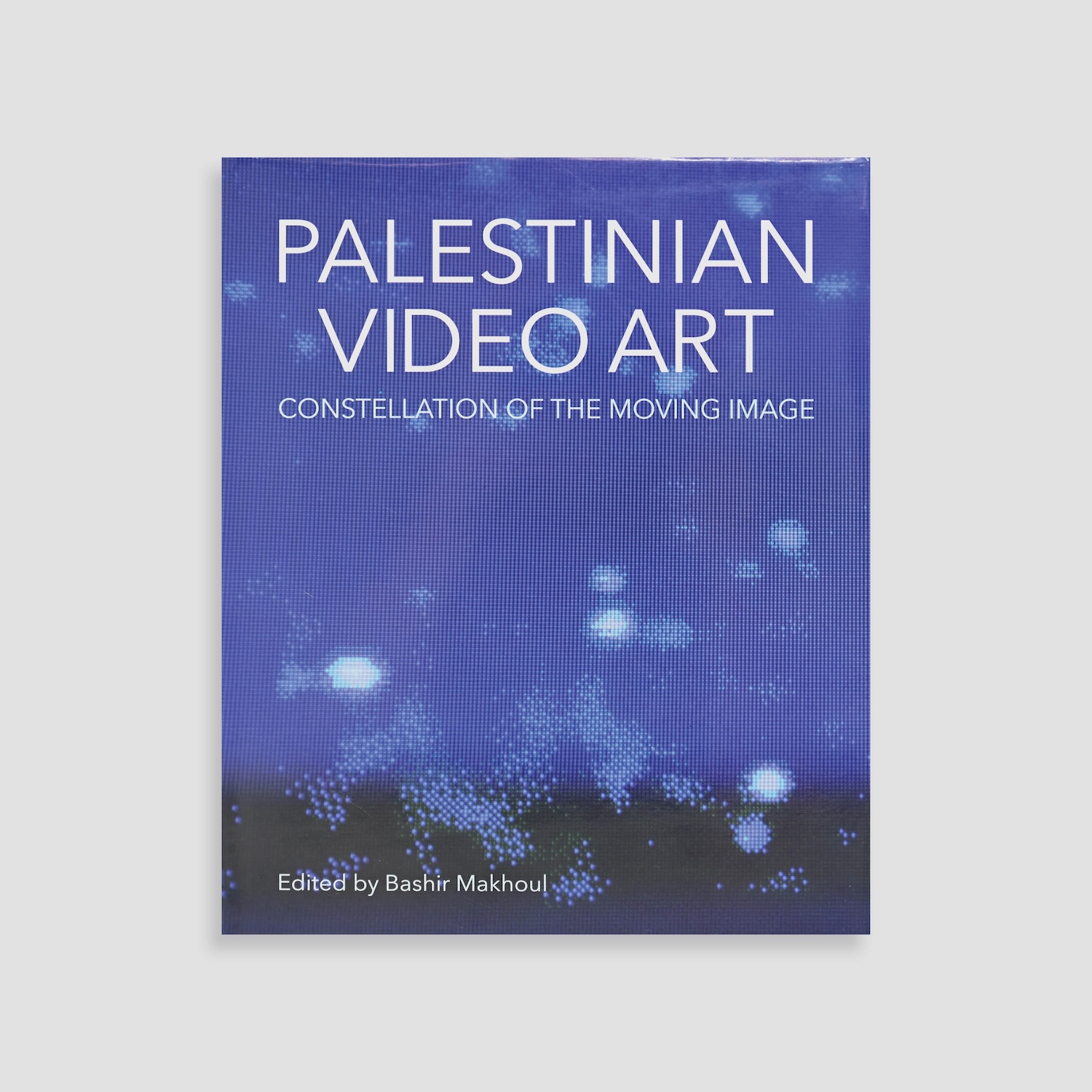
Palestinian Video Art: Constellation of the Moving Image Edited by Bashir Makhoul
Palestinian art and, in particular, video art shares a complexity of definition with many evolving concepts. Globalisation, for example, Jonathan Harris argues in his introduction to ‘Globalisation and Contemporary Art’, is a matter of intellectual and scholarly convergence, bringing together interdisciplinary dynamics and analytical traditions.
Each contributor to this volume presents his or her own reading of this emergent convergence, considering ways of understanding the conditions, production and meanings of Palestinian video art as a constellation of diverse practices. They pay special attention to how the artists, who, always, in part, have been responsible for the production of Palestine, are now almost automatically addressing a global audience. Technology has transformed the transmission of culture, and video art has been one of the primary beneficiaries of the deterritorialisation of Palestine. The sheer extent and volume of the Internet’s reach at the very least indicates the importance of the audio-visual in contemporary global life. So much has it become a naturalised part of our ordinary lives that the Internet, in the form of Youtube, need no longer urge us, as it once did, to ‘broadcast’ ourselves. A new form of digital interpellation has been naturalised. What does it mean to be told to ‘broadcast yourself’? There is perhaps a silent existential threat in refusing this interpellation – the ‘self’ that does not broadcast will not exist, at least on YouTube.
Palestinian video production proposes a more productive approach to considering the ‘becomingness’ of Palestinian identity; a process rather than a fixed state, Palestinian identity is quintessentially not a determined position but a matter of flux. It is always in the state of becoming: emergent, developing, evolving. Building upon, yet moving beyond, current post-colonial theoretical accounts of Palestinian identity-formation, this volume addresses how migrations within Palestine and the post-’48 Zionist state, as well as dispersals from those territories to other states, have contributed to the definition of Palestinian-ness and the increasingly globalised identity this creates. Particularly for those Palestinians who occupy the doubly-precarious position of living within a host state, their resulting complex identity has further necessitated the creation of a plural, globalised, international identity.
This volume is avowedly a work of the present, in which I attempt to recognise the formation of the contemporary idea of Palestinian video art, starting from the position that Palestinian identity is in a state of becoming. This volume aims, therefore, in the spirit of Benjamin, to remain “imperfect and incomplete”.